
Scientific Tools to Assess the Environmental Impact of Materials, Products & Processes.
Through Life Cycle Assessment (LCA) studies and dedicated technical analyses, we analyse how the different stages of the life cycle, from the production of raw materials to the end of life, contribute to the overall environmental impacts.
Sustainability is not About a Single Step in The Production Process.
To really understand the environmental impact of a product, it is necessary to look at the entire system: materials, industrial processes, methods of use and end-of-life management.
For this reason, sustainability strategies require scientific tools capable of analyzing complex environmental data and supporting design decisions based on technical evidence.
In our work, we integrate environmental analysis, laboratory activities and applied research skills to interpret this data and transform it into useful information for the development of more environmentally efficient materials, products and technologies.
Sustainability as a Design Process
Sustainability is now increasingly entering the early stages of material and product design. Choices relating to raw materials, production processes and end-of-life management methods can significantly influence the overall environmental impact.
Analyzing these variables allows you to compare different scenarios and identify more efficient design solutions.
In this context, environmental analysis tools become an integral part of eco-design processes, allowing materials and products to be developed taking into account their environmental performance throughout their life cycle.
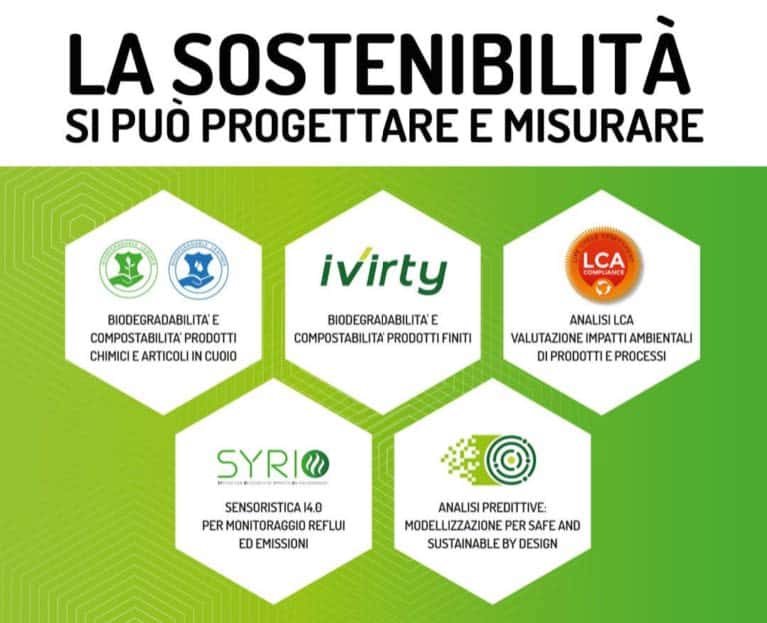
Life Cycle Analysis (LCA)
The Life Cycle Assessment is one of the most comprehensive tools for assessing the environmental impact of products and processes.
Through this methodology, we analyze all phases of the life cycle of a production system, considering elements such as:
- Power consumption
- Greenhouse gas emissions
- Use of natural resources
- Water consumption
- Waste generation
- Impacts on ecosystems
The LCA analysis makes it possible to identify the phases of the production cycle that generate the greatest environmental impacts and to evaluate alternative scenarios in terms of materials, technologies and end-of-life management.
Eco-design and Development of Sustainable Materials
Environmental analyses can become design tools for the development of new materials and products.
In our work, we integrate LCA data with laboratory expertise and applied research to analyze:
- Alternative materials
- Innovative formulations
- Sustainable packaging solutions
- Production processes with lower environmental impact
This approach makes it possible to design materials and products taking into account their environmental performance from the outset.
End-of-life of Materials
An important part of sustainability strategies concerns the end-of-life management of products.
The choice between recycling, composting, or other forms of recovery can significantly affect the overall environmental impact of a material.
For this reason, sustainability analyses are often integrated with studies on the behavior of materials in different end-of-life scenarios, such as:
- Recycling of materials
- Industrial composting
- Biodegradation in different environments
- Energy recovery
These assessments allow us to understand how materials fit into circular economy systems.
Do you Want to Analyze The Environmental Impact of Your Product?
If you are developing a new material, packaging or production process and want to assess its environmental impact throughout its entire life cycle, we can define the most suitable LCA study for your project.
FAQ – LCA & SUSTAINABILITY
What is a Life Cycle Assessment (LCA)?
A Life Cycle Assessment (LCA) is a scientific method used to evaluate the environmental impact of a product, material or process throughout its entire life cycle. This includes raw materials, production, transport, use and end-of-life scenarios such as recycling, composting or energy recovery.
Why is LCA important for sustainable product development?
LCA helps identify which stages of the life cycle generate the greatest environmental impacts. This allows companies to compare alternative materials, processes and end-of-life options, and to make design decisions based on measurable environmental data rather than assumptions.
Can ARCHA support eco-design projects?
Yes. ARCHA uses LCA studies, laboratory analyses and applied research to support eco-design and the development of more sustainable products. This may include the evaluation of alternative materials, new formulations, sustainable packaging solutions and lower-impact production processes.
What types of products or materials can be assessed?
LCA and sustainability studies can be applied to a wide range of products and materials, including packaging, plastics, bioplastics, industrial materials, innovative formulations and production processes. The study is always tailored to the specific goals, system boundaries and technical characteristics of the project.